
Horror, Violence, and Conscience
Halloween is on its way, and our culture is already drowning in real blood.

A few nights ago I asked my wife if she wanted to watch a scary movie with me. Growing up in the ’90s, horror and zombies were part of my childhood diet. October always meant marathons of the classics, a steady dose of fear for “fun.” I can still remember the thrill of sneaking in a late-night slasher flick, and the strange satisfaction of being “scared” while still feeling safe on the couch. But now as a traditional Catholic, the pull isn’t the same. I still feel the appeal, the way a soldier craves the adrenaline in combat, but I also feel the conflict.
And then came the Charlie Kirk assassination. His execution, captured in one of the most grotesque videos ever to circulate widely online, was a moment of cultural rupture. I can’t compare it to anything other than the propaganda tapes ISIS used to release; barbaric displays of murder meant to harden hearts and intimidate enemies. Except this wasn’t the Middle East. This was Utah. This was America.
I can’t help but think, what do images like this do to us? What does it mean when our entertainment choices, like the horror movies I’ve loved for a long time, mirror the brutality that now unfolds in real life?
My Love of Movies
My love for film started in my senior year of high school, in what I thought would be a throwaway “easy A” film studies class. But it turned out to be fascinating. We didn’t just watch movies, we dissected them; camera angles chosen to manipulate emotion, dialogue structured like music, and themes layered beneath scenes to guide the viewer down a particular path.
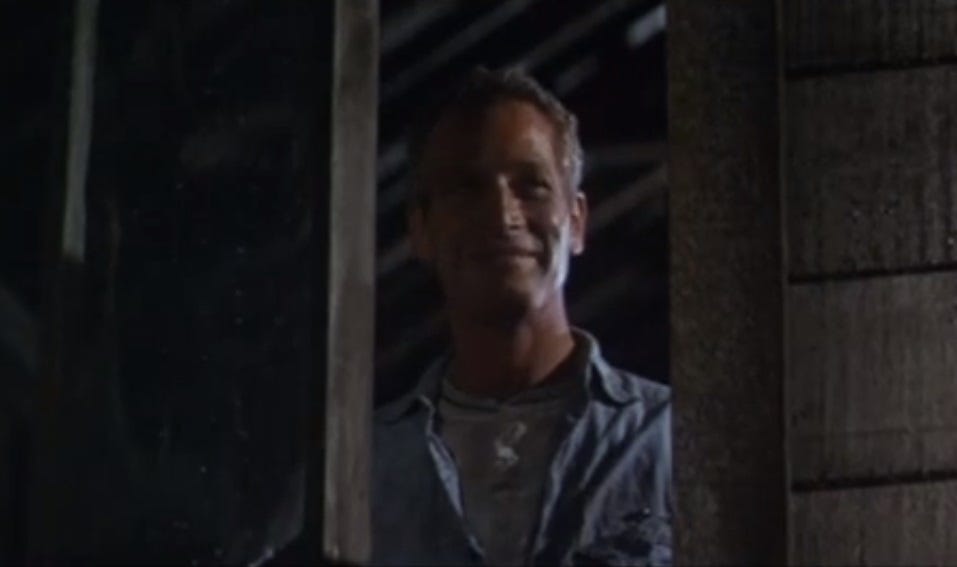
I still remember analyzing Cool Hand Luke (1967, directed by Stuart Rosenberg). On the surface, it’s the story of a rebellious man who won’t submit to authority. Paul Newman plays Luke, a prisoner who refuses to conform, even if it means being beaten down. But beneath the plot is a commentary on freedom, conformity, and dignity under oppression. Our teacher broke down how the film’s camera angles forced the viewer to feel Luke’s isolation and how the symbolism of eggs, chains, and crosses shaped the story.
More than a decade later, I still find myself analyzing why directors frame scenes the way they do; why certain dialogue lingers, and how story arcs manipulate emotion. This is why my relationship with R-rated films is complicated. I still admire the craft, but craft and content aren’t the same thing. A beautifully shot scene of blasphemy or gore is still blasphemy and gore.
A Modern Horror Example
The other night, I asked Emily to watch Weapons with me. It’s a new horror film told in a nonlinear style, piecing together intersecting storylines. At first, it feels like a puzzle: mysterious children running through the night, a teacher suspected of their disappearance, parents behaving strangely, and an elderly woman whose appearance is something out of a nightmare. As the film unfolds, we learn she’s a dying witch who manipulates children, enchants adults, and feeds on human life to sustain herself. The climax is violent, disturbing, and bizarrely triumphant as the children rise against her.
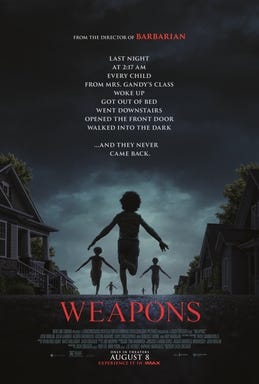
From a film studies standpoint, it was brilliant. Expertly crafted, suspenseful, and clever. From a moral standpoint it left me wondering, what did I gain from watching this?
Characters repeatedly took the Lord’s name in vain. Witchcraft was not just implied but central to the plot. And the violence was graphic: murders, torture, enchantments, and ritual. Sitting there, half of me was impressed by the director’s style. But the other half (my conscience) kept screaming, “Turn it off. This is not feeding your soul. This is feeding something else.”
The Conflict
Before my reversion, I would have enjoyed this movie without a second thought. Not because I liked evil, but because I enjoyed the thrill, that “edge of your seat” experience. But now I have a wife, children, and a vocation to lead them toward Christ. I am no longer free to shrug and say, “It’s just entertainment.” Because it isn’t.
Emily wasn’t entertained. She wasn’t amused by my old appetite for scary films. She was unsettled and disturbed. And instead of leading her toward peace, I had dragged her into darkness for the sake of my own nostalgia.
What we watch leaves residue. It lodges in the imagination. It conditions us, either toward reverence or irreverence, toward vigilance or toward numbness. And when I looked over and saw my wife unsettled by what I had chosen for us, I realized I had failed. I had chosen my old appetite for “scary fun” over her peace and over her holiness.
So I can’t help but ask, why were we free to watch Charlie Kirk’s assassination unfold without a single graphic warning?
Where to Draw the Line
Here’s where I’ve landed: horror may be artfully made, but the spiritual cost doesn’t appear to be worth it. As men, we are charged with guarding our homes, not just against intruders at the door, but against corruption through the screen.
Against the backdrop of Charlie Kirk’s execution, or the brutal stabbing of Iryna Zarutska on the Charlotte metro, I can’t ignore the parallel. Our culture is already desensitizing us to violence. Social media feeds are filled with real blood, real suffering, real brutality, and most people scroll past like it’s nothing. Horror films, once a guilty pleasure, now feel like training wheels for this numbness.
I find myself asking where the line really is. Should we watch only what edifies? Surround ourselves only with voices that lift us higher? If I question horror films, what about other R-rated films, or even podcasts and influential people I follow for “news” and commentary? Is there even such a thing as neutral entertainment? Or does every story, every song, every screen carry a moral weight? I don’t claim to have all the answers. But I do know the questions themselves matter, and they’re ones every man should be asking if he intends to lead his family towards heaven.
About the author: Logan Reed is a U.S. Army veteran and former intelligence contractor, now living with his wife Emily and their family on a small farm in Western North Carolina. A husband, father, and traditional Catholic, he is a member of the Holy Name Society at Saint Anthony’s of Padua in Mount Holly, NC. He writes from the perspective of both Soldier and layman, exploring the intersection of faith, culture, and morality in a time of crisis for both Church and country. All views expressed are his own.